How to Choose the Right Aggregates for Your Construction
Coarse Aggregates are the hidden strength providers of concrete. Although they remain invisible once concrete hardens, they make up 60% to 75% of the total concrete volume and play a vital role in ensuring structural stability, load-bearing capacity, and long-term durability. If you are constructing a residential home, commercial building, industrial facility, or infrastructure project, selecting the right aggregates is just as important as choosing quality cement and steel.
Who Should Read This?
🏠 Individuals planning build a new house 🏗️ Builders and contractors 🏛️ Architects and designers 👷 Civil and Structural Engineering Students
At a Glance
- Coarse aggregates make up to 60–75% of concrete volume and are the primary load-bearing component of concrete.
- Choose IS 383:2016 compliant aggregates to ensure strength, durability, and long-term structural performance.
- 20 mm angular crushed granite (blue metal) is the preferred aggregate for most residential RCC construction.
- Well-graded, angular aggregates improve bonding, reduce voids, and minimize cement consumption.
- Key quality limits (IS 383:2016):
- Water absorption: ≤ 2%
- Clay lumps: ≤ 1%
- Dust passing 75 μm sieve: ≤ 3%
- Flakiness + Elongation Index: ≤ 40% (preferably < 30% for high-strength concrete)
- Avoid weathered, flaky, rounded, or contaminated aggregates, as they reduce concrete strength and durability.
- Always source aggregates from a reputable quarry and verify quality through visual inspection and laboratory tests for major projects.
- Poor-quality aggregates can lead to lower compressive strength, cracking, steel corrosion, and reduced service life of the structure.
- Never choose aggregates based on price alone—quality has a direct impact on safety
What Are Aggregates?
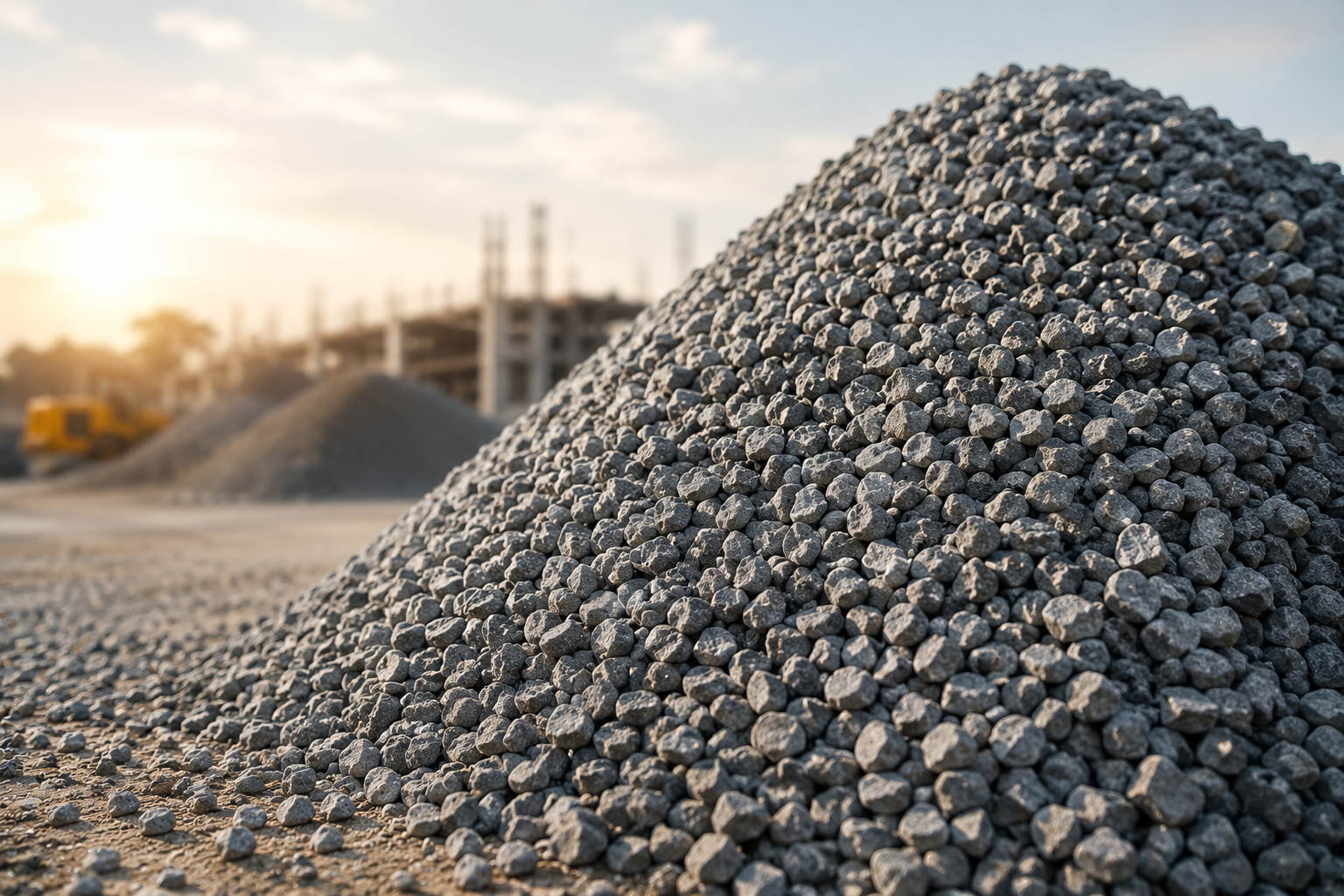
Aggregates are inert granular materials such as crushed stone, gravel, and manufactured stone particles. These Coarse aggregates are mixed with Fine aggregate(Sand), Cement, and water to make concrete. They serve as the primary filler material in concrete, contributing significantly to its compressive strength, dimensional stability, and overall structural integrity. Coarse aggregates, commonly known as jelly stones, consist of crushed granite or other durable rocks available in various sizes such as 10 mm, 20 mm, and 40 mm.
They are primarily used in foundations and footings, Columns, Beams, Slabs, retaining walls, and pavements. These Coarse aggregates are responsible for carrying most of the structural loads in a building.
Decoding IS 383:2016 -Coarse and Fine Aggregate for Concrete
For coarse aggregates (commonly known as blue metal), IS 383:2016 is the Indian Standard that specifies the quality requirements for their use in concrete. It defines the essential physical and mechanical properties that aggregates must meet to ensure the production of strong, durable, and reliable concrete.
Classification by Material Origin
IS 383:2016 – Coarse and Fine Aggregate for Concrete groups aggregates based on where and how they are sourced. When selecting materials for your concrete mix, you will encounter two main types:
Natural Stone Aggregates: These are produced by crushing heavy natural rocks like granite, basalt, or quartzite. For structural elements like columns and beams, crushed granite is universally preferred.
Manufactured & Recycled Aggregates (RCA): IS 383:2016 – Coarse and Fine Aggregate for Concrete permits the use of processed recycled concrete aggregates for certain construction applications. However, their use in reinforced cement concrete (RCC) is limited, while higher proportions may be allowed in plain cement concrete (PCC) as specified by the standard.
Standard Mechanical Strength Thresholds
Before aggregates are approved for structural concrete, samples undergo rigorous machine testing to measure their resistance to crushing, impact, and wear.
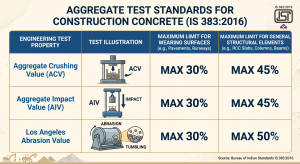
The above value describes: If a batch of aggregate has a high percentage (above 45% or 50%), it means the stone is soft, brittle, and breaks easily under pressure. For strong concrete, you always want lower numbers, which prove you are using rock-solid, high-quality granite that can easily carry your building’s load.
Particle Shape Limits (Flakiness & Elongation)
The physical shape of individual stones dramatically alters how well the concrete flows during pours and how much cement paste is needed to bind it.
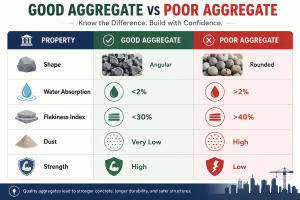
IS 383 states that the combined Flakiness and Elongation Index must not go over 40%. For heavy-duty or high-strength concrete designs, structural engineers prefer keeping this number below 30%. The Risk: Flat, thin (flaky), or needle-like (elongated) stones snap easily under compaction. They create large empty pockets (voids) in the mix, which significantly reduce the ultimate compressive strength of your concrete.
Limits on Harmful Impurities & Moisture Absorption
Impurities hidden within an aggregate pile can cause internal chemical reactions that degrade concrete or corrode embedded steel over time. The code draws a strict line on these harmful materials:
-
Fine silt/dust (passing 75-micron sieve): Max 3.0% for crushed natural stone.
-
Clay lumps: Max 1.0%
-
Coal and soft lignite particles: Max 1.0%
-
Water Absorption Rate: Ideally, coarse aggregates should absorb no more than 2.0% of their total dry weight. Highly porous stones soak up the mixing water, which disrupts your calculated water-cement ratio and weakens the final concrete cure.
Why Are Aggregates Called the Hidden Strength Provider?
Many people believe cement alone determines concrete strength. But in reality, aggregates form the structural framework within the concrete.
Good-quality aggregates help to increase compressive strength, improve load-bearing capacity, reduce shrinkage cracks, enhance durability, improve resistance to abrasion, and lower overall construction costs by reducing excessive cement consumption.
Things to consider while choosing an aggregate
Size
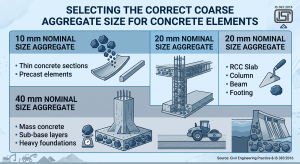
Different structural elements require different aggregate sizes.
| Aggregate size | Typical Application |
| 10mm | Thin RCC section, Precast Concrete |
| 20mm | Residential RCC, Beams, Columns, Footing |
| 40mm | Mass concrete, PCC, Raft foundation, Retaining wall |
Table 1.0: Size and applications of the coarse aggregate
Shape
Angular crushed aggregates create better mechanical bonding than rounded stones, resulting in stronger concrete. Rounded aggregates provide less workability than angular and irregular aggregates.
Grading
Well-graded aggregates reduce voids, improve workability, and require less cement, making concrete stronger and more economical. Builder’s Recommendation: For residential RCC construction, 20mm angular crushed granite (blue metal), IS 383 compliant, from a reputable quarry, is suitable.
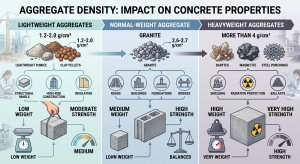
Density of Coarse Aggregate
The density of aggregate determines the concrete’s strength and weight.
How Can You Identify Good Quality Aggregate?
One good quality aggregate must satisfy
- Water absorption should ideally be ≤2%.
- Clay lumps: ≤1%.
- Dust passing the 75 µm sieve: ≤3%.
- Flakiness + Elongation Index: ≤40%.
- Preferred residential aggregate: 20 mm.
Always Do Quality Checks Before Buying Aggregates
Check whether the aggregates:
- Have a uniform size ( Angular)
- Are free from visible dust
- Do not contain clay lumps
- Have sharp edges
- Show no signs of weathered or flaky stone.
For major projects, laboratory tests such as Aggregate Crushing Value (ACV), Aggregate Impact Value (AIV), water absorption, and specific gravity should be conducted to ensure compliance with Indian Standards.
Expert Tips from Structural Engineers
- Do not purchase aggregates solely based on price.
- Ensure aggregates come from a reliable source.
- Use the correct aggregate size for each structural element.
- Avoid contaminated or weathered materials.
- Maintain proper storage to prevent mixing with soil or debris.
- Always follow the structural engineer’s specifications.
For residential buildings, 20 mm angular crushed granite conforming to IS 383:2016 is the safest and most economical choice. Never compromise on aggregate quality merely to reduce material costs because aggregates contribute approximately 70% of concrete volume and significantly influence strength and durability.
-
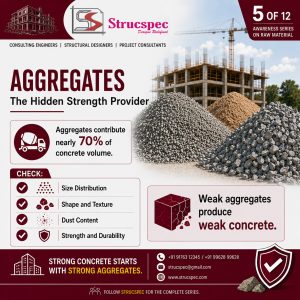
Image 5.0: Quality aggregates form nearly 70% of concrete and are the foundation of strong, durable, and long-lasting structures. Expert Verdict
Coarse aggregates are not just fillers—they are the structural backbone of concrete. Their quality directly influences compressive strength, durability, crack resistance, and the service life of every building.
For residential reinforced concrete (RCC) construction, 20 mm angular crushed granite (blue metal) conforming to IS 383:2016 remains the most reliable and cost-effective choice. Before purchasing, always verify that the aggregates are clean, well graded, free from clay and excessive dust, and sourced from a reputable quarry.
Remember: Saving a small amount on low-quality aggregates can result in costly repairs, reduced structural performance, and a shorter building lifespan. Investing in quality aggregates is an investment in the safety, durability, and long-term value of your structure.
Frequently Asked Questions (FAQs)
Which aggregate size is best for house construction? For most residential reinforced concrete structures, 20 mm coarse aggregate is the preferred choice because it offers an excellent balance between strength and workability. Can poor-quality aggregates weaken concrete? Yes. Inferior aggregates reduce concrete strength, increase cracking, and shorten the lifespan of the structure.
Can river pebbles be used instead of crushed stone for house construction?
River pebbles are not recommended for structural RCC work. Its rounded shape provides weaker bonding with cement paste compared to angular crushed stone, and Tamil Nadu’s mining regulations have made river gravel scarce and inconsistent in quality. Use crushed granite (blue metal) for all structural elements.
Conclusion
Even though aggregates are hidden within concrete, they are one of the most important building materials in modern construction. They influence the strength, durability, stability, and long-term performance of every structure. Choosing the right aggregates is not merely a material selection; it is an investment in the safety and longevity of your building.
Whether you are building your dream home or managing a large construction project, never compromise on aggregate quality. Consult an experienced structural engineer, source materials from trusted suppliers, and follow recommended construction practices. If you have any doubts regarding the selection of construction materials, feel free to contact us at https://www.strucspec.com/
About the Author
Er. R. Sivashanmugam, M.Tech., MIE, Chartered Engineer
Sivashanmugam R is a Structural Consultant with over 25 years of experience in structural design, RCC detailing, structural audits, and construction quality assurance. Through Strucspec, he has contributed to the design and supervision of hundreds of residential, commercial, and industrial projects across India.
Source References
- IS 383:2016 – Coarse and Fine Aggregate for Concrete
- IS 456:2000 – Plain and Reinforced Concrete
- IS 2386 -1 – Methods of Tests for Aggregates