How to Select the Best Sand for Construction
Introduction
Sand is one of the most important materials used in construction. Sand is Technically called as Fine Aggregate in Civil Engineering terms. It plays a vital role in concrete, mortar, plastering, and flooring works. Choosing the right type of sand can significantly affect the strength, durability, and quality of a building. Therefore, understanding how to select suitable sand is essential before starting any construction project.
Why Is Sand Important for Strong and Durable Construction?
Fine aggregate (sand) enhances the gradation of concrete by filling interstitial voids between coarse aggregates, thereby improving density, reducing permeability, and increasing the overall strength and durability of the concrete. It improves the workability of concrete and mortar while contributing to the overall strength of the structure. The right type of sand ensures proper bonding, minimizes shrinkage cracks, and enhances the durability of construction elements.
Types of Sand Used in Construction
1. River Sand
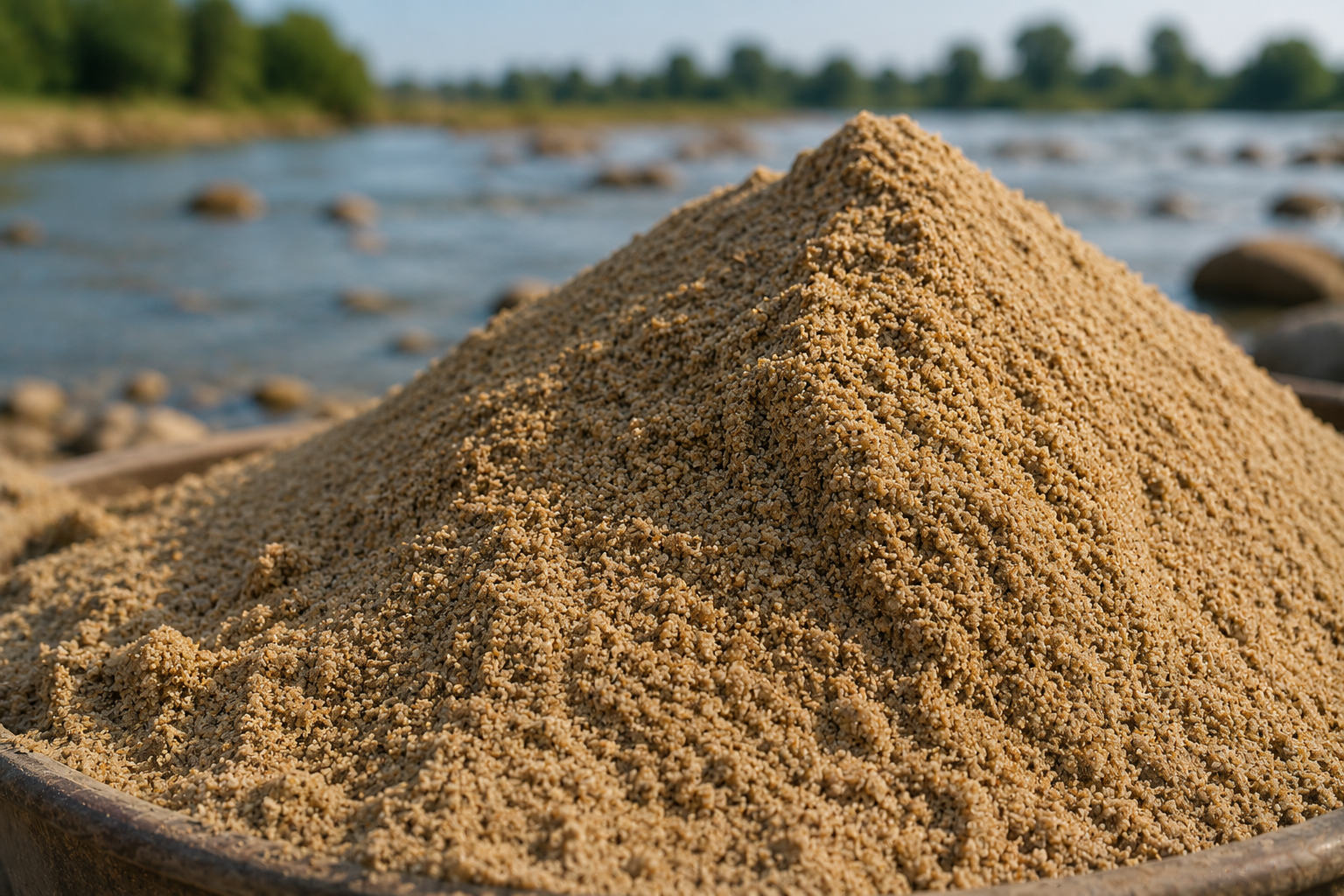
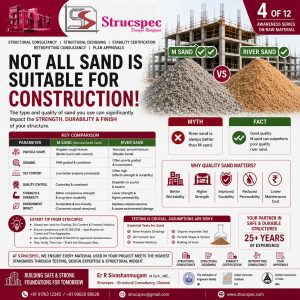
River sand is a naturally occurring fine aggregate obtained from riverbeds and riverbanks through natural weathering and erosion of rocks over thousands of years. It is one of the most widely used fine aggregates in construction due to its clean, rounded particles, excellent grading, and good workability. River sand plays a vital role in producing high-quality concrete and mortar by filling the voids between coarse aggregates and improving the bond with cement paste.
A good-quality river sand should be clean, well-graded, hard, durable, and free from silt, clay, organic matter, salts, and other harmful impurities. Excessive silt or clay can reduce the bond between cement and aggregates, leading to lower strength and durability. Therefore, river sand should always be tested before use, especially for structural concrete.
River sand is widely used in reinforced cement concrete (RCC), brick masonry, plastering works, floor screeds, tile bedding, general mortar works, and the manufacturing of precast concrete products due to its excellent workability, proper grading, and strong bonding properties.
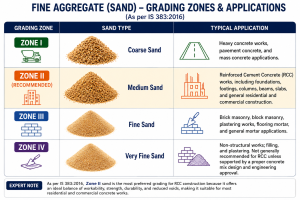
IS 383:2016 – Coarse and Fine Aggregate for Concrete – Specifies
- Requirements for natural and manufactured fine aggregates.
- Particle size distribution (grading).
- Limits for deleterious materials.
- Physical and mechanical properties.
- Quality requirements for concrete production.
Silt is one of the most common impurities found in river sand. Excessive silt reduces the bond between cement and sand, increases water demand, lowers concrete strength, and may lead to cracks and poor durability. Therefore, checking the silt content before using river sand is a simple but important quality control step.
The Jar Test is a quick and commonly used field method to find out the silt content in river sand.
2.M – Sand (Manufactured Sand)
Manufactured Sand (M Sand) is a fine aggregate produced by crushing hard granite or other durable rocks in specially designed crushing and screening plants. M Sand is manufactured under controlled conditions to achieve the desired particle size distribution, shape, and quality. Nowadays, M Sand has become one of the most preferred alternatives to river sand due to its consistent quality, environmental sustainability, and excellent performance in concrete. M Sand is manufactured by crushing hard rocks into fine particles, followed by screening and washing to remove excessive fines and dust. The resulting material is well-graded, clean, and free from organic impurities, making it suitable for both structural and non-structural construction works.
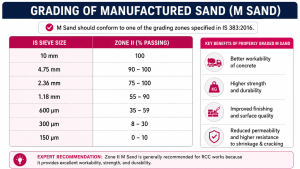
High-quality M Sand, when combined with proper concrete mix design, quality cement, graded aggregates, and adequate curing, can produce concrete that performs as well as or, in many cases, better than concrete made with natural river sand.
Factors to Consider When Selecting Sand
Check for Cleanliness
Good quality sand should be free from clay, silt, dust, organic matter, and harmful salts. Excessive impurities can weaken concrete and reduce the lifespan of the building.
Particle Size Distribution
Particle Size Distribution (PSD), also known as grading, refers to the proportion of different-sized particles present in sand. Proper grading ensures that the sand particles fit together efficiently, reducing voids and producing concrete with better workability, strength, and durability.
Conduct Simple Field Tests
Always perform a simple bottle test to check silt content. Fill a bottle with sand and water, shake it, and let it settle. If you see a thick silt layer on top, avoid using that sand for construction.
Conclusion
The right sand can significantly influence the strength, stability, and durability of a building. Whether you choose river sand or M-Sand, always verify its quality, cleanliness, and suitability for the intended application. By following proper selection practices and sourcing materials from trusted suppliers, you can ensure a strong foundation and long-lasting construction. If you have any doubts regarding construction material / structural designs, feel free to contact us at https://www.strucspec.com/. Remember, quality construction begins with quality materials, and selecting the right sand is the first step toward building with confidence.